How I Built This · Journal 2 · JOUR 3270
Etsy.
In 2005 a furniture maker in Brooklyn couldn't find anyone to sell his desks to. Rob Kalin and three friends built the place where makers could sell to each other. This is the story of the business, in ten answers.
Brandyn Ippolito · October 2026 · from episode 566 of NPR's How I Built This with Guy Raz, aired October 30, 2023
Start with who, and why
Question one
Who and what did I choose, and why?
- I chose Rob Kalin, the founder of Etsy, born and raised in Boston.
- He's essentially a high school dropout: a GED and a 1.4 GPA, minimum-wage jobs, nighttime demolition, then art school and NYU's Gallatin School. He has two decades of woodworking behind him.
- I chose Etsy because its customer base is the same one I'm going after with my current project, a tool that helps makers keep track of the shows they go to. It's a like-minded product, and I figured I could learn something from this.
Question two
When and how did they start?
June 2005
Two and a half months to build. Servers ordered from Newegg, assembled at home, racked in Secaucus, New Jersey.
- 2005. A buddy of his who made furniture wanted to sell it on eBay, and eBay had no real interest in handmade. That was the pain point.
- He built Get Crafty, a makers' forum, with Chris Maguire. Its founder didn't want selling on her site, so he got her blessing to build a separate marketplace.
- The first sellers were mostly women. Posts on Get Crafty and Craftster blew it up; they never spent money on advertising.
- It reminds me of what I'm doing now with Apply Season: researching makers' pain points to see if there's even a market, trying to get ten or twenty people to sign up.
Question three
What does the company do?
- Etsy is a marketplace where makers sell to buyers.
- At first it was only for handmade; later craft supplies, then vintage. Buyers paid through PayPal, which eBay owned.
- Rob says Etsy's main customer is now the buyer, not the seller. It has scaled to close to 100 million active buyers and about $2.5 billion a year.
- What I like is that they never leaned on advertisers. Sellers pay a fee per item plus a percentage of the sale, and that keeps the mud out of the sale itself.
- Handmadethe only rule at launch: you made it
- Vintage & suppliesthe categories that followed
- A listing fee, then a cut of the saleno advertising, by design
- Makers, mostly womenthe first sellers, by Kalin's account
Question four
What challenges have they experienced?
- The chicken and the egg: buyers and sellers each needed the other first. The sellers already existed as a community, so he brought them to the shop to attract the buyers.
- The software wasn't good, so they bought hardware to cover for it. Long days, sleeping on a camping pad.
- He made Maria Thomas CEO in 2008, came back in 2010, and in 2011 was fired without notice, over lunch.
- He grew too fast, with friends instead of experienced people. But I'd also be afraid of bringing a business-world person in and getting pushed out of my own company. My plan is to grow slow and organic, Central Florida first, and assess before any big decision.

Question five
Where did the start-up money come from?
- The first money was a $50,000 check from a customer, a man whose apartment bar he had built. Then that investor's brother and a friend who owned a restaurant.
- Venture money came later: about $250,000 two years in.
- Same scare for me. I've taken business loans before and it bit me in the end. With investors I'm responsible to somebody besides my customers, so I want to build organically and hope I never need a fundraising phase.
- $50,000the first cheque, 2005, from a man whose apartment bar Rob had built
- $250,000the round about two years in, at a $1.5 million valuation
- $1Msales through the site in year one
- $2.5BEtsy's revenue a year by 2023, per Raz
Question six
What is a typical day like?
- At Etsy: 18 hours a day in a freezing office, sleeping on a camping pad, handing out postcards at craft fairs.
- Now: the Catskills, a Montessori school he helped start, and high-fidelity speakers that sell for around $50,000 a pair.
- Probably less stress, probably a lot less money. For myself, I'd rather have smaller businesses, a couple of employees, and not 70 or 80 hours a week.
“The heroes of all of that are the sellers.”
Rob Kalin, about 82 minutes in
Question seven
Why do they do this?
- He really cared about the crafters and makers: creating a community, a bond between people in the crafts like he was.
- His own answer at the end: hard work is the part he controls, but luck and some kind of providence come first. And the heroes of all of it are the sellers.
Question eight
What is their goal?
- He had global ambitions from the start. But after he was gone and Etsy shifted to the buyer, it became more of a business, worried about shareholders rather than the original focus.
- So the goals were not the same. His goal was to help people. The company's goal was to make money.
- Keep your values and your integrity in place, and if it's going to grow beyond them, it's the founder's responsibility to stop.
Question nine
What makes them unique?
- Handmade only. No advertisements. The seller was the primary customer and the community came first. Jared Tarbell's visuals, like browsing by color, gave it a look nobody else had.
- I'd take both: community first, and a look of its own. I don't want people saying my thing is a copy of that with another outfit on.
Question ten
Who is their competition?
- Direct competition with eBay; he said that plainly. They were stuck accepting PayPal, which eBay owned.
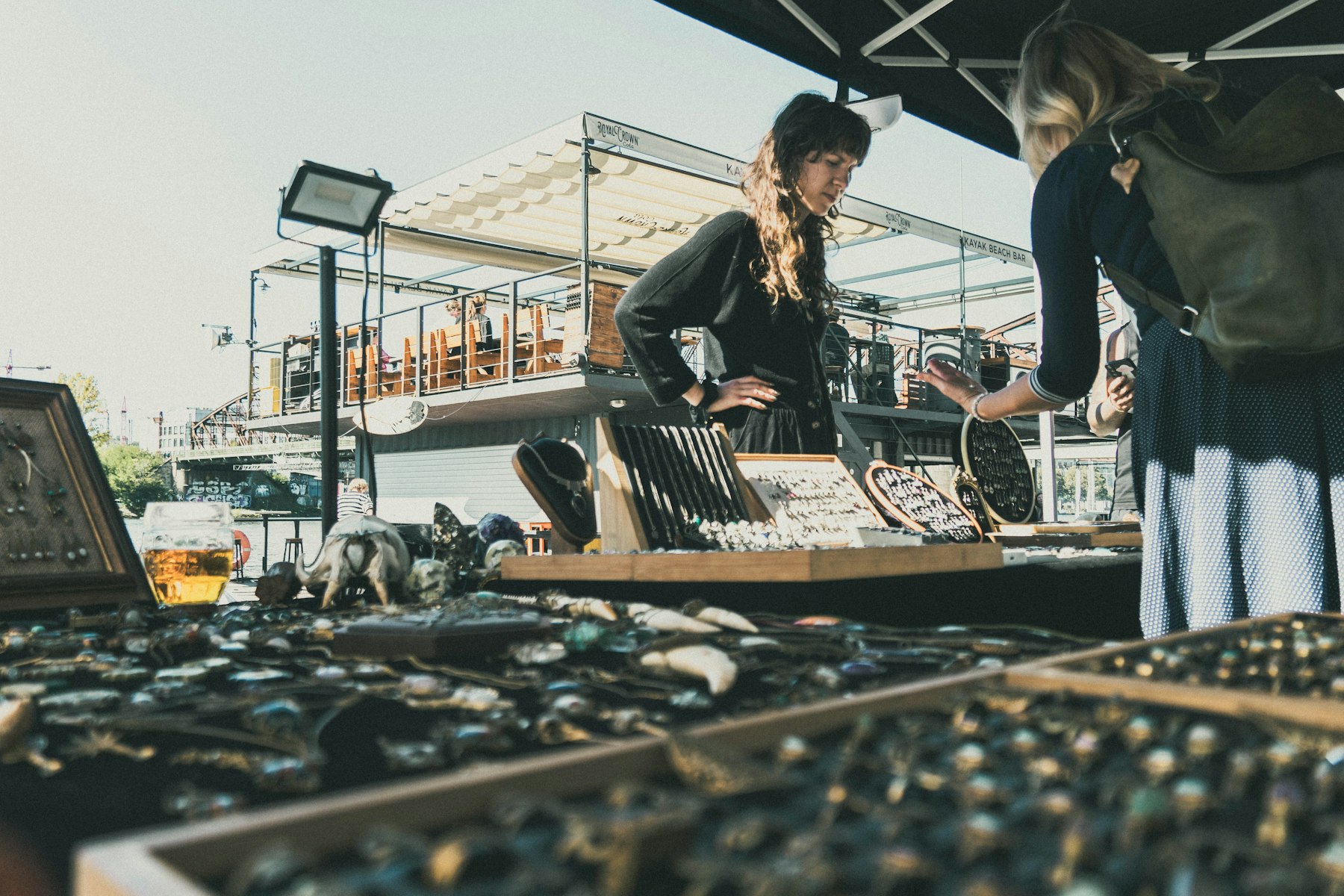
- Craft fairs and people physically selling were small-time competitors. Outside the podcast, I'd add Amazon, Facebook Marketplace and TikTok Shop today.
- The two tiers: the handmade marketplace, exactly what I'm focusing on, and the generic version where any maker can sell. My market could be Etsy's customers, but I wouldn't be competing with Etsy. How can I augment what Etsy is doing?
The takeaway
What I'm taking from Rob Kalin into my own idea.
- My makers are already gathered at the shows. The question I'm carrying into the Lean Canvas: how do I augment what Etsy is doing, instead of competing with it?
Source: Guy Raz, How I Built This, “Etsy: Rob Kalin,” NPR, October 30, 2023 (episode 566, 1 h 21 min). Photographs from Unsplash under the Unsplash License. All text my own. Word count: 834.